
Find Who Owns a Wisconsin Property
Start with the parcel, not the name. Wisconsin has no statewide owner-name assessment search. The V12 map can omit or redact owner fields. So a name there is never the final word. An address search often lands on a local assessor card. The county Real Property Lister can supply the parcel number and legal description. The tax roll and the recorded instrument can differ. When they do, the newest deed is the source to check.
Choose the taxing municipality, not the mailing city or ZIP. A postal city can differ from the city, village, or town that actually assesses the parcel. Streets cross jurisdiction lines too. The State Cartographer's map locates the county. The Department of Revenue assessor directory then routes you onward. It points to the municipality holding the local roll.
- Find the county and municipality that govern the situs address.
- Search the local assessor or RPL record and copy its owner field, tax key, and legal description.
- Search the county Register of Deeds for the latest instrument affecting that parcel.
- If the named owner is an LLC or corporation, check its exact legal name in DFI's Corporate Records Search.
- Compare dates and retain both records if the local roll has not yet caught up with the deed.
An address search can return several parcels. Narrow the list with municipality, unit number, tax key, or legal description before comparing names. A tax bill may name a mailing recipient who differs from the deed's grantee. Addresses also change between assessment rolls. Trusts, estates, and companies need exact wording. Preserve the full name and its capacity, because small differences in punctuation or representative language can signal a different party altogether.
Wisconsin Assessor Names Need a Parcel
Madison's assessor shows how local owner search works. Its last-name mode takes a partial or full name. An address-range search can list a whole street block. A name alone can return a same-name stranger or miss an LLC, trust, married name, or estate. Before calling it a match, pair the result with its parcel, mailing address, tax-roll year, and legal description.
Other Wisconsin municipalities use different fields. Some offer no online assessment search at all. DOR's local assessor hub is the statewide route to the correct office. Ask that custodian how the owner field is updated, and whether paper assessment cards or public terminals exist.
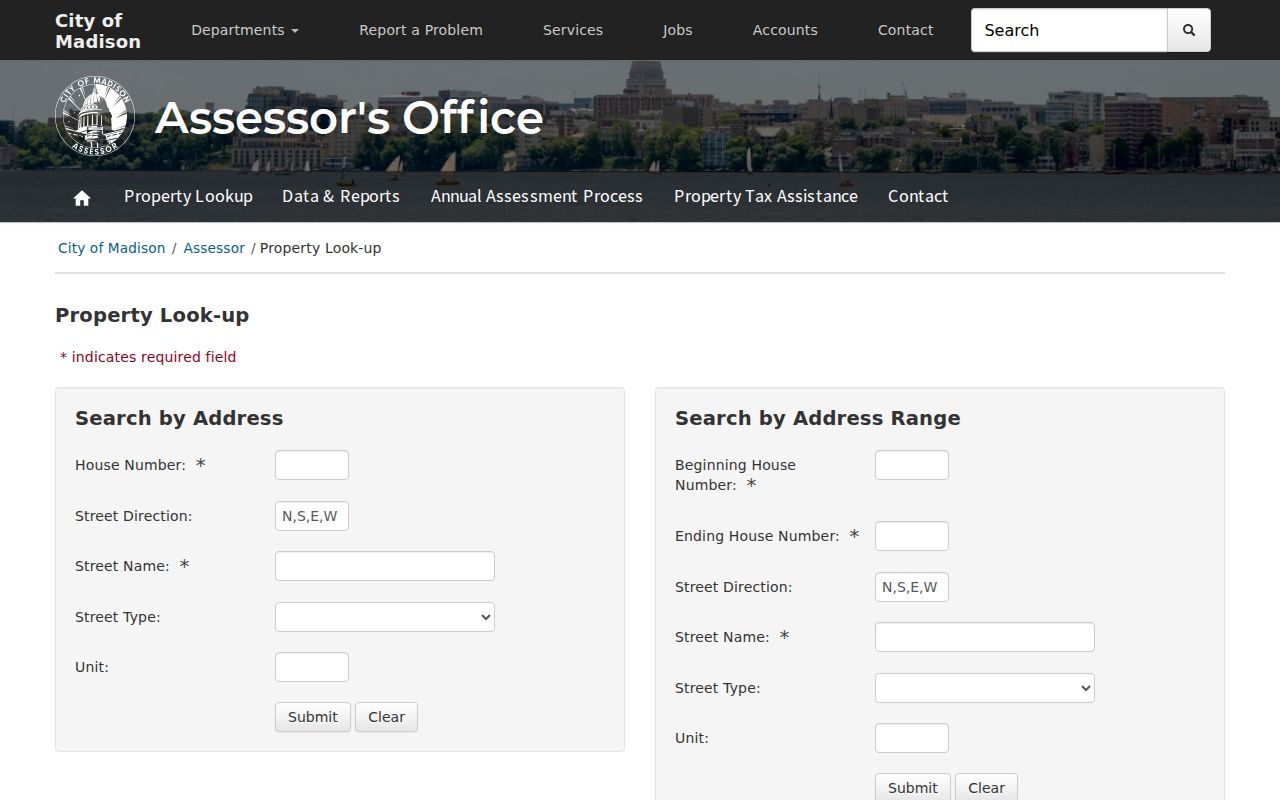
The screenshot shows one municipality's owner-name and parcel modes, not a statewide owner database.
Wisconsin Entity Owners and DFI
A company-named parcel needs the exact grantee spelling. Copy it from the assessment card or deed. Search DFI Corporate Records under current and old names. The record can show the legal entity name and type. It may also list the effective date, registered agent and office, DFI ID, status, filing history, and annual-report year. Annual reports and charter records may be ordered, and an online certificate can follow purchase.
DFI lists no domestic LLC members, phone numbers, or every beneficial owner. A registered agent accepts service of process. That role does not make the agent an owner or occupant. For a trust or estate, follow the deed's trustee or personal-representative name. Use probate or recorded transfer instruments where they apply. The county Register of Deeds keeps the recorded ownership instrument.
The Wisconsin DFI Corporate Records Search supports entity and registered-agent searches.
Wisconsin Property Owner Record Sources
Owner data appears in several records. The municipal assessor tracks taxable property and value. The county RPL keeps parcel and legal-description details. The county Register of Deeds records the transfer instrument, while GIS simply repeats attributes supplied by local sources. DFI can identify an entity, but not every person behind it.
| Source | Owner Info It Gives | Access |
|---|---|---|
| Assessor / RPL | Owner field, mailing address, parcel ID, legal description | Local portal or office; DOR lookup routes to the custodian |
| Register of Deeds | Grantee named in recorded deed and its legal description | County index, counter, terminal, or copy request |
| Statewide V12 map | Local owner attribute where supplied, with county/source dates | Public map, REST service, or download; may be blank/redacted |
| DFI Corporate Records | Entity name, registered agent, office, ID, status, filings | Public state entity search; domestic LLC members not listed |
The owner field names the party a custodian records. It is not proof of occupancy. Nor does it show who benefits from a trust or company. A mailing address may be a business office or post-office box. Match the parcel, date, and legal description before connecting anyone to the property.
To confirm a name, open the most recent deed affecting the parcel. Read the grantee line, recording date, document number, and legal description. Search screens differ by county. Some emphasize grantor and grantee names, document numbers, or date ranges. A deed image may require a separate copy order. Do not call the first name result a match. The description must agree with the assessor or RPL parcel.
Some counties and municipalities offer no online owner search. Use its public counter instead. Ask the custodian for an existing assessment card, parcel record, or recorded instrument. Wisconsin's Public Records Law, Wis. Stats. §§ 19.31–19.39, permits oral requests unless a security requirement or another law demands writing. The authority should respond as soon as practicable and without delay. No statewide ten-day deadline exists. Include the county, municipality, parcel or tax key, record type, and date range. Ask about copy charges before ordering.
Wisconsin's Statewide Map Can Be Blank
The V12 parcel layer pulls owner attributes from county and municipal sources. A blank name has two usual causes. The local source may not have submitted it. Or the field may have been redacted. Either way, the parcel still has a recorded owner. Kenosha County's prior statewide layer blanked every owner name under a county-board resolution. Other counties set their own redaction policies. They also work from different source dates.
Treat the map as a pointer, not an endpoint. Use it to identify the source county and parcel key. Then continue in the local RPL or the assessor record. Keep the parcel date, tax-roll year, source, and load date alongside your result. Local data can run ahead of the statewide map. So cite both dates when they disagree.
The Statewide Parcel Map and the V12 source layer offer different doors. Each leads into the same statewide aggregate.
Wisconsin Transfers Need Date Checks
Timing trips up many deed searches. A deed can be recorded before the annual assessor roll shows the new owner. RPL ownership and legal-description data follow the latest recorded instrument. The municipal roll, though, moves on its assessment cycle. If an online owner field looks stale, compare its tax-roll year and update date against the newest recorded deed. Do not assume the systems changed together.
DOR's RETR search adds transfer-return context and now routes through My Tax Account. It can help you locate a receipt or a county document number. Assessor PAD data, however, may omit rejected non-arm's-length transfers. A missing sale result does not prove no conveyance happened. Confirm the record with the county Register of Deeds.
For the current owner field and the lag between filing and roll updates, see the Wisconsin current owner record method.
Safe at Home Changes Address Display
Wisconsin's Safe at Home program gives participants who face safety threats an assigned address. State and local agencies generally use that substitute address. The statute's limits still apply. Land-record systems can also flag protected ownership or mailing data. Act 235 and related rules permit that.
A blank, substituted, or redacted address can be lawful. Don't try to fill the gap by stitching together unrelated search results. Don't republish a sensitive identifier from an old image, either. An official result may carry a protected field. Ask the record custodian what can be released. MyVote and DMV systems follow separate privacy rules and are not alternate owner searches.
The Wisconsin's Safe at Home address guidance explains why a substitute address may appear in public records.
Limits of a Wisconsin Owner Lookup
An assessor owner field has real limits. It does not tell you who lives at the property, reveal a trust's beneficiaries, or prove clear title. A tax roll can lag a deed. A map can show a blank owner field. A name match can point to a different parcel. Privacy rules add another layer, since Safe at Home and other confidentiality statutes can substitute or redact addresses and owner details.
Use for lawful property research. Do not use Wisconsin owner information to stalk, threaten, or harass a person. A records lookup is not a title opinion; confirm ownership with the recorded instrument and the responsible custodian.