
How Wisconsin Property Search Works
Every Wisconsin property search starts local. County and municipal offices hold the controlling parcel fields. For a house, the address is the easiest clue. An owner name works too. It can return several parcels, though. A parcel ID is the strongest join key once you have it. The statewide parcel layer can point to the source county. But it does not replace a local assessor, RPL, or Register of Deeds record.
Keep the same parcel in view as you move between systems. The address locates it. The tax key joins local parcel and bill records. The legal description ties the parcel to deeds and plats. A mismatch may mean an old address, a split parcel, or a different municipality. It is rarely a bad record.
- Choose the county and municipality that govern the address, then search the local assessor or RPL by address.
- Copy the parcel ID, owner field, situs address, mailing address, and legal description from the result.
- If the assessor has an owner-name or parcel mode, use it to check a variant or confirm the same parcel.
- Carry the exact parcel or legal-description key into the county Register of Deeds index.
- Save the tax-roll year and source date, then contact the custodian if the web result is missing or incomplete.
The parcel comes first. Once you have it, turn to the detailed Wisconsin deed search, since a property search is never a substitute for a full chain-of-title review.
Madison's Property Search Field Set
Madison shows how one city handles this. The City of Madison Assessor offers search modes by address, address range, and owner last name. It also searches by parcel number. Its portal also links property details, tax receipts, sales by area, and a map. These fields are Madison's own, not a statewide standard for every Wisconsin municipality.
| Field Label | Type | Required | Options / Format Notes |
|---|---|---|---|
| House Number | Text | Yes, address mode | Unit may be separate |
| Street Direction | Text or dropdown-like input | No | N, S, E, W |
| Street Name | Text | Yes | Portal may normalize the name |
| Street Type | Select | No | Options are local to the form |
| Beginning / Ending House Number | Text range | Yes, range mode | Lists a street block; direction and type remain optional |
| Owner's Last Name | Text | Yes, name mode | Partial or full name; “Smith, J” and “Smith, John & Nancy” are examples |
| Parcel Number | Text | Yes, parcel mode | Madison example: 070924207016; preserve leading zeroes |
Match the tool to the parcel. Use the Madison assessor search only for a Madison address, and let DOR's assessor hub route any other parcel to the municipal assessor that serves it.
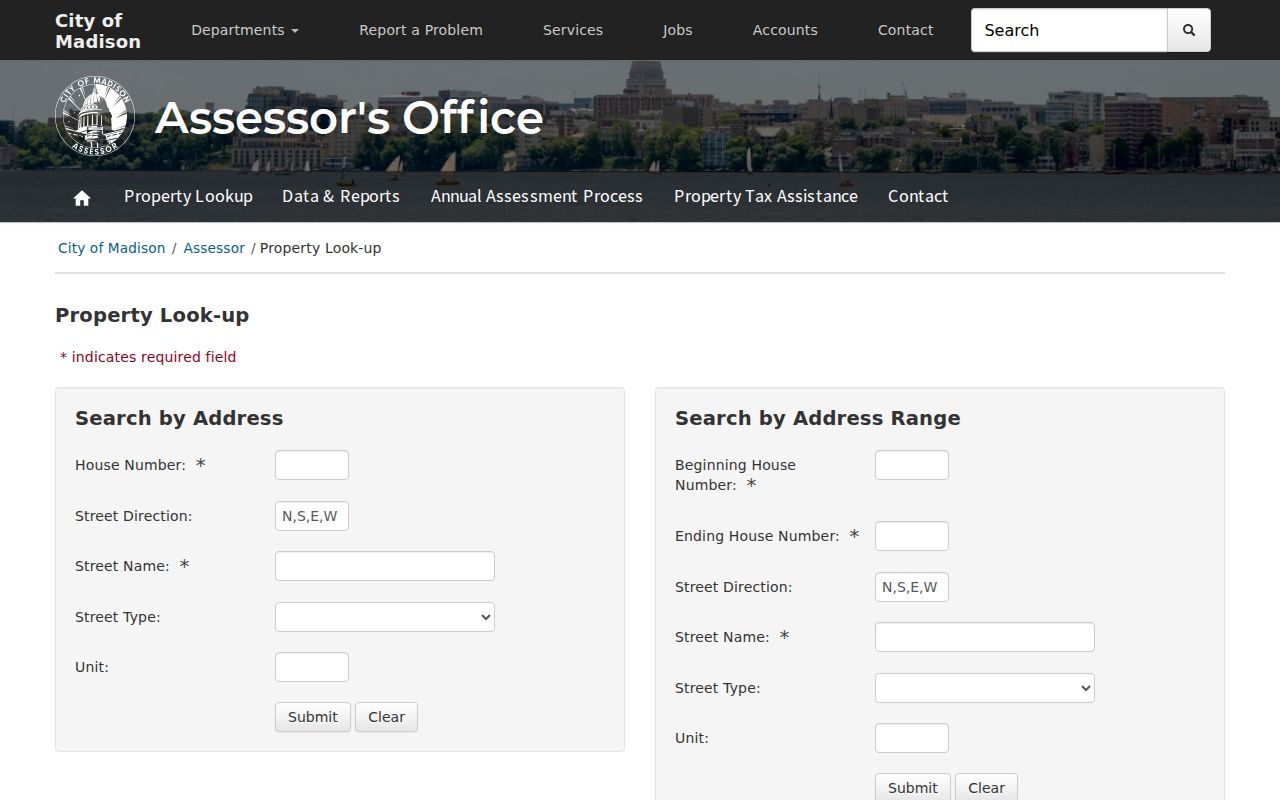
This portal image shows one city's search modes. A neighboring municipality may use a different vendor or require an office request.
What a Wisconsin Parcel Search Returns
Wisconsin's V12 statewide parcel schema is the best published inventory of what a parcel search can return. Fields vary by source county. A local parcel card can show more. It may include a sketch, last sale reference, exemption flags, building details, tax history, and valuation history; a blank field simply means that item was not supplied or does not apply.
| Primary / secondary owner | Names submitted by the local source; may be blank or redacted |
|---|---|
| Mailing / physical address | Where tax mail goes and where the parcel is located |
| Parcel and tax IDs | State ID, parcel ID, tax parcel ID, and parcel date |
| Tax year and assessed values | Tax-roll year; land, improvement, total, and MFL/FCL land values |
| Estimated value and tax | Estimated fair market value; gross and net property tax |
| Class and acreage | Property class, auxiliary class, assessed/deeded/GIS acres |
| Source and location | County, source FIPS, load date, coordinates, and site address |
- Situs address
- The physical location tied to the parcel, which can differ from its mailing address.
- Parcel ID
- A local key for joining the parcel with assessor, GIS, deed, and tax records.
- Owner of record
- The owner name shown by a particular custodian, not proof of who occupies the land.
- Legal description
- The recorded land description, such as lot and block, metes and bounds, or section-town-range.
A sale date or document reference may surface in a local system, outside the uniform statewide parcel card. Treat each result as a lead. It is not a title opinion or survey.
Use RETR for Wisconsin Transfer Clues
DOR's Real Estate Transfer Return search adds sale context once a parcel is known. Its public route moved to My Tax Account in January 2026. The “Search Wisconsin Property Data” tool covers county and municipality, property address, receipt number, county document number, and combined searches. The legacy page once offered five years of data and CSV export. The new route advertises downloads. Its layout may change.
RETR is not the deed index. DOR warns that PAD is incomplete. Gifts, exempt-fee transfers, partial interests, and other automatically rejected sales may be missing from the assessor sales set, so a missing PAD result proves nothing. Narrow the search by place and date range, save the receipt or county document number, then check the county recording.
The DOR RETR migration notice has the details.
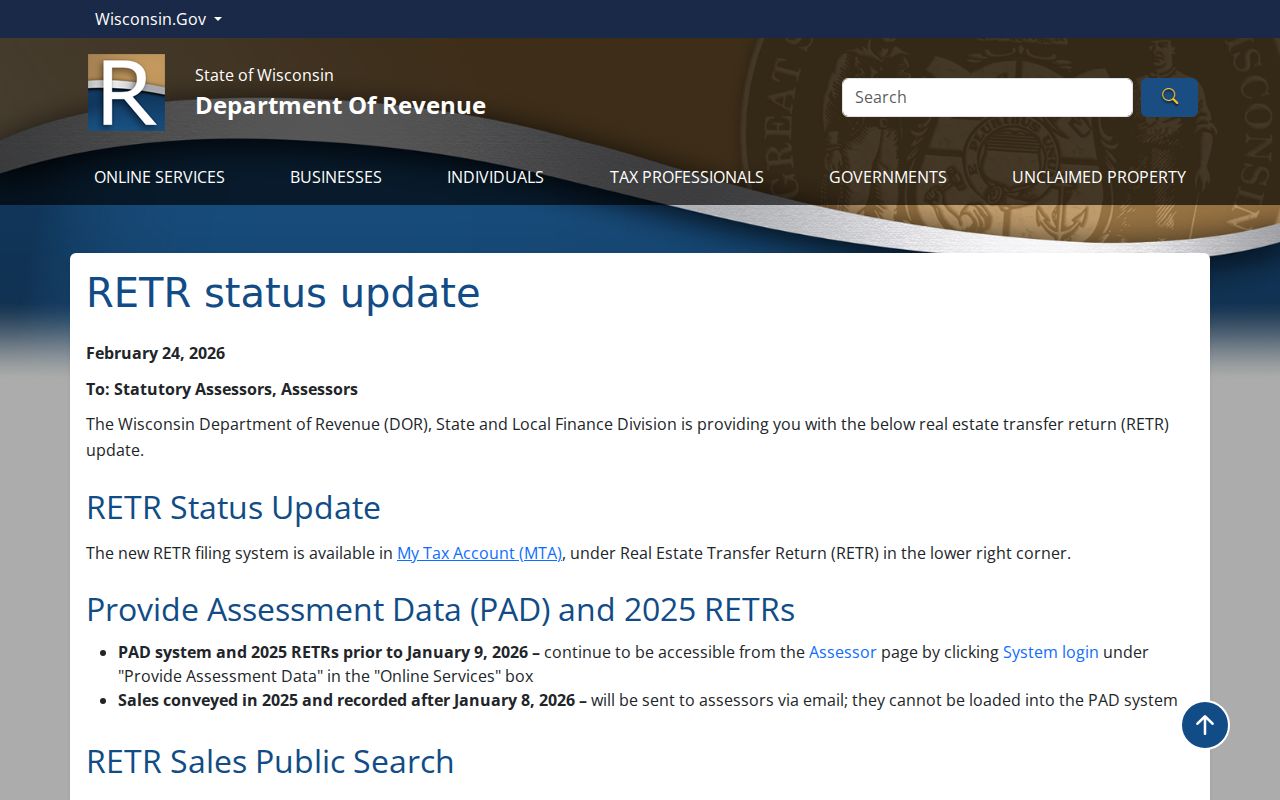
That notice keeps RETR, deed images, and PAD search distinct.
Keep Mailing and Situs Addresses Apart
Tax notices go to the mailing address. The situs address is where the land sits. They often match, but not always. A mailing address can be a post-office box, a business office, a management address, or a registered agent. A vacant parcel may lack a situs entirely. A condominium can hold one parcel with separate units, and Wisconsin's V12 fields keep mailing and physical addresses apart, along with standardized site address and ZIP data.
ZIP code is postal geography, not a legal boundary. A city mailing name can describe a parcel in an unincorporated town, and ZIP service areas can cross municipal lines. Let the county and municipality shown by the parcel source guide you to the right assessor, treasurer, and Register of Deeds. Never assume a mailing address shows where the owner lives.
Carry the Parcel Key to the Deed
The assessor's result hands you two keys: the parcel ID and the legal description. Both belong in your deed search. At the county Register of Deeds, look up the newest deed by party, parcel, document number, or legal description. Do not lean on street addresses. Older deeds often lack one entirely.
Jot down the recording date, the grantee, any consideration or transfer-return reference, and the full legal description; those details tie the record to the land itself, not to a same-name owner of record. The Real Property Lister maintains parcel and legal-description data from recorded documents, while the assessor's annual roll can lag a recently filed deed. Parcel IDs also change. Search the old key too. After a split or a combination, the retired number and the recorded description still lead to the same land.
Each county holds its own deed index and images. Fees and searchable years differ. A Wisconsin property search ends well when it yields a verifiable document number or parcel key, with the deed-records page covering that office's full search process.
When an Assessment Card Is Not Online
Wisconsin municipalities are encouraged, not required, to post assessment data online. A blank search result is a routing problem. It is not proof that no property card exists. Pull the parcel key from the tax bill or the municipal clerk, then ask the local assessor for the assessment roll or the paper property record card. DOR requires that card to be producible on request. The office cites a seven-year retention period.
Reach the assessor by phone or email, stop at the counter if the office offers one, or mail a focused request. Wisconsin's Public Records Law permits oral requests unless security or another law calls for writing. Name the custodian, parcel, record type, and date range. Ask for electronic copies when available. If locating records could exceed $50 or the total cost could exceed $5, request a fee estimate. The Wisconsin DOR assessor hub points to municipal assessor contacts and assessment guidance.
V12 Downloads Preserve Source Dates
The State Cartographer's Office offers statewide V12 and county downloads, a schema, a change log, and a REST service. File geodatabases are available. Earlier releases also offered shapefiles. Save the metadata with any download. Parcel date, tax-roll year, load date, source FIPS, and parcel source show when and where the data entered the state layer.
Use the V12 map for orientation. County and municipal data may be newer. Statewide owner, address, and value fields can sit blank or redacted, so a null field signals neither an ownerless parcel nor a tax exemption. For a current bill, a deed copy, or a boundary question, follow the source back to the local custodian. The State Cartographer's Office download page lists V12 data and documentation.
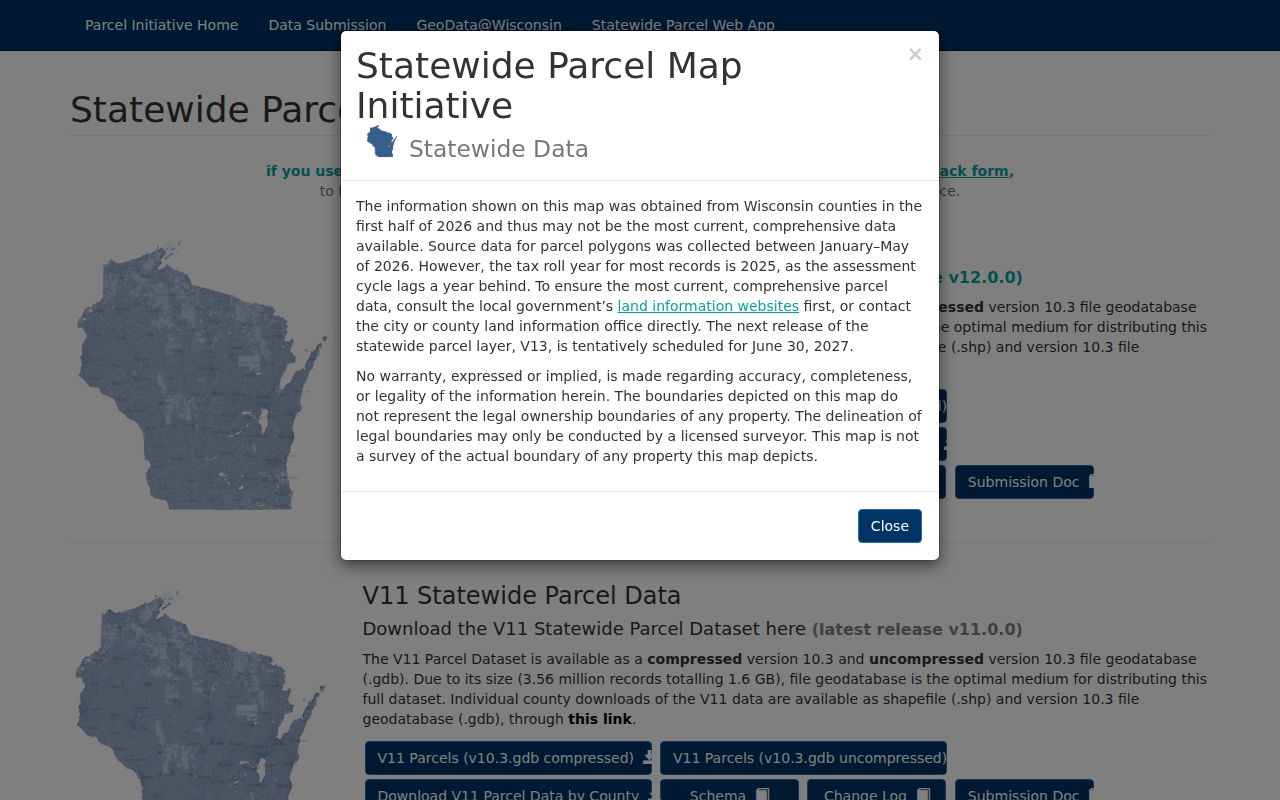
Saved counties and source dates keep parcel discovery repeatable.
Parcel Splits Change Search Keys
Parcel numbers do not last forever. When a split, combination, or annexation retires a tax key, the ID on an older bill or deed stops matching the new one. Keep both keys. Then compare the legal description, the plat or certified survey map, and the recording reference. Identifier formats are local. No Wisconsin-wide pattern applies.
Addresses shift too. Municipal addressing, rural 911 coordination, road naming, and annexation are handled locally, so a street address on a deed or city directory can differ from today's situs. The county GIS or Real Property Lister office, or the local clerk, can connect an old address to the current parcel.
Owner Search Needs Name Variants
Owner mode helps when one person holds several parcels. A name alone is not unique. Search initials, punctuation, suffixes, married names, and both name orders. Test the exact entity or trustee name from the assessor or the deed. Estates are trickier. One may appear as "Estate of" or under a personal representative, while a life estate may sit in the deed language rather than the assessor's owner field.
For an LLC or corporation, DFI's Corporate Records Search confirms the entity name, registered agent and office, entity ID, status, and filing history. Domestic LLC members are not a standard field there. A registered agent is not automatically the parcel's owner of record either. Match the entity result back to the recorded instrument and parcel before drawing conclusions.
Wisconsin offers no single statewide owner-name assessment search. Local assessor tools may allow owner searches. Each must be checked one municipality at a time.
Milwaukee's 1930 Address Change
A current parcel search in Milwaukee can fail on an old address. The reason is simple. In 1930 the city renumbered its streets and renamed many of them. A directory supplement from that year converts earlier addresses to the new ones. Milwaukee Public Library holds city directories from 1847 to the present. Address browsing is available from 1921 onward. Its local-history collections also hold tax rolls covering 1846 through 1984. They hold premises records for buildings standing between 1880 and 1888 in reverse, that is 1888 through 1980. Start with the reverse address section, then chase the name into the alphabetical directory. Each volume has a key explaining owner-renter marks, spouse notes, and abbreviations. Directories show occupancy, not title. For proof of a historic owner of record, check the tax roll, a deed, or the probate file. Holdings differ among Wisconsin libraries, so call ahead where possible. The Milwaukee Public Library local-history collections describe the directories and their address indexes.
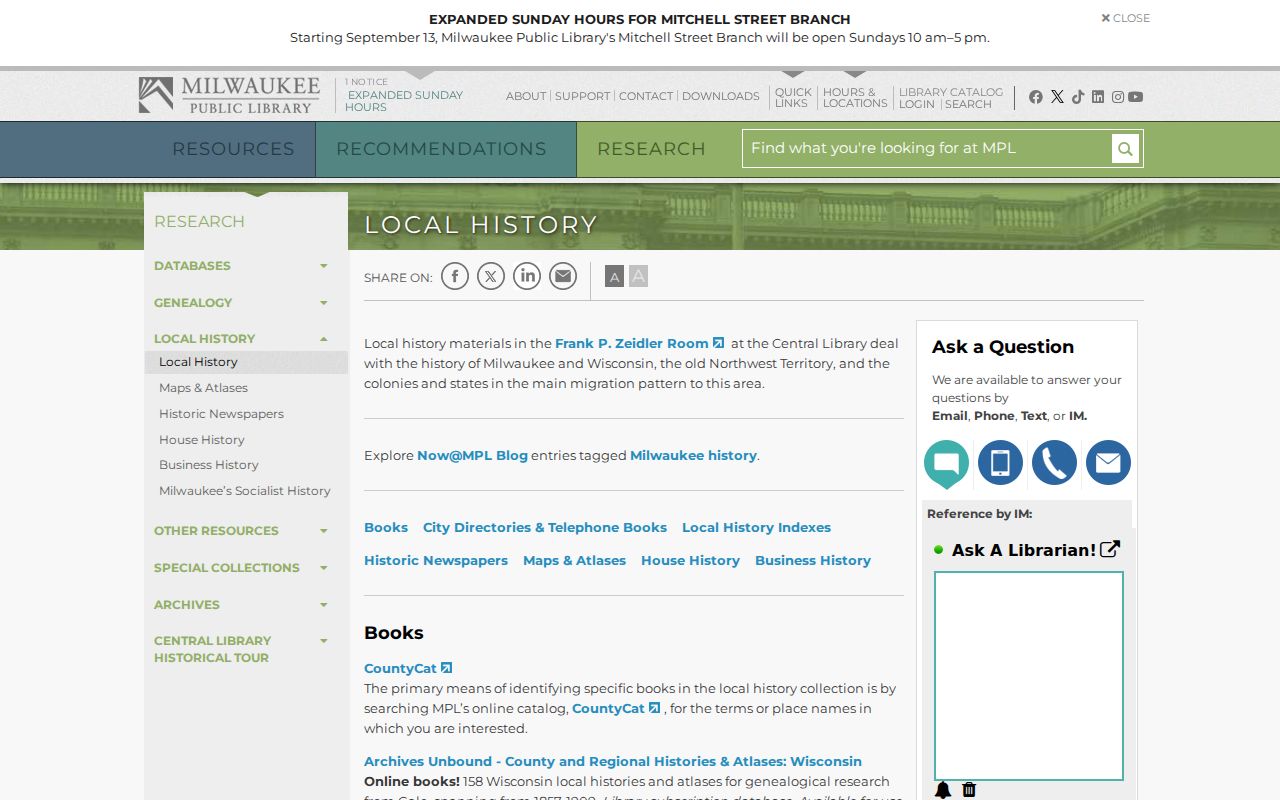
Milwaukee's address converter bridges 1930 street numbers to their modern equivalents, and it applies only to that city.
Wisconsin Search Keys: Address, Owner, Parcel
Pick the key that fits what is already known. An address pins down a single site. An owner name can reach several parcels. A parcel ID works best for cross-referencing, once the local format is clear. Every match still depends on county and municipality, especially when an address, ZIP, or city mailing name crosses a government boundary.
| Search Key | Best For | Where It Works | Watch Out |
|---|---|---|---|
| Address | Locate a home, business, or improved parcel | Municipal assessor, county GIS, V12 map | May be absent, renumbered, or different from the legal description |
| Owner name | Find several parcels or confirm an owner field | Local assessor/RPL, county ROD, DFI for entity identity | Trusts, estates, spelling variants, and same names can hide a match |
| Parcel ID / tax key | Join assessor, map, tax, and deed references | Local assessor/RPL, GIS, treasurer, ROD | Format varies; splits and mergers can retire a key |
Not a title search. A Wisconsin property search gathers record leads; it does not establish clear title or settle a boundary. Confirm the current deed with the Register of Deeds and use a title professional or licensed surveyor when the question requires that review.