
Wisconsin Owner-of-Record Fields
Owner fields differ by source. The statewide V12 parcel schema spells out what Wisconsin collectors report: primary and secondary owner names. It also covers full mailing and physical addresses, parcel identifiers, the tax-roll year, plus parcel and load dates. A municipal card can go further. It may add the legal description, a sale reference, exemption flags, and building details. Blank or redacted owner data can be lawful. It can also simply mean the source supplied no value.
| Primary / secondary owner | The name fields supplied by the local source |
|---|---|
| Mailing address | Where tax mail is sent; may differ from the parcel |
| Situs / physical address | Where the land is located |
| Parcel ID / tax key | The local join key for assessor, map, deed, and tax accounts |
| Tax-roll year / parcel date | The period represented by the record |
| Source / load date | The county or municipal feed and its place in the state layer |
| Latest deed reference | In a local card, the document number or recording date to verify at ROD |
The owner of record is whoever the listing agency names. It does not identify an occupant. Nor does it capture every person with an interest inside a trust or company. A mailing address is not proof of residence. To confirm the current owner, check the newest instrument recorded for that same parcel.
Not every Wisconsin municipality posts a searchable property page. Department of Revenue guidance on property-record cards says a paper card must be producible on request. It cites a seven-year retention period. Ask the municipal assessor for the card. Give staff the county, municipality, situs address, and parcel or tax key. Mention the tax-roll year and owner field you are checking so they pull the right version.
The Wisconsin V12 parcel schema describes these statewide fields and where local sources stop.
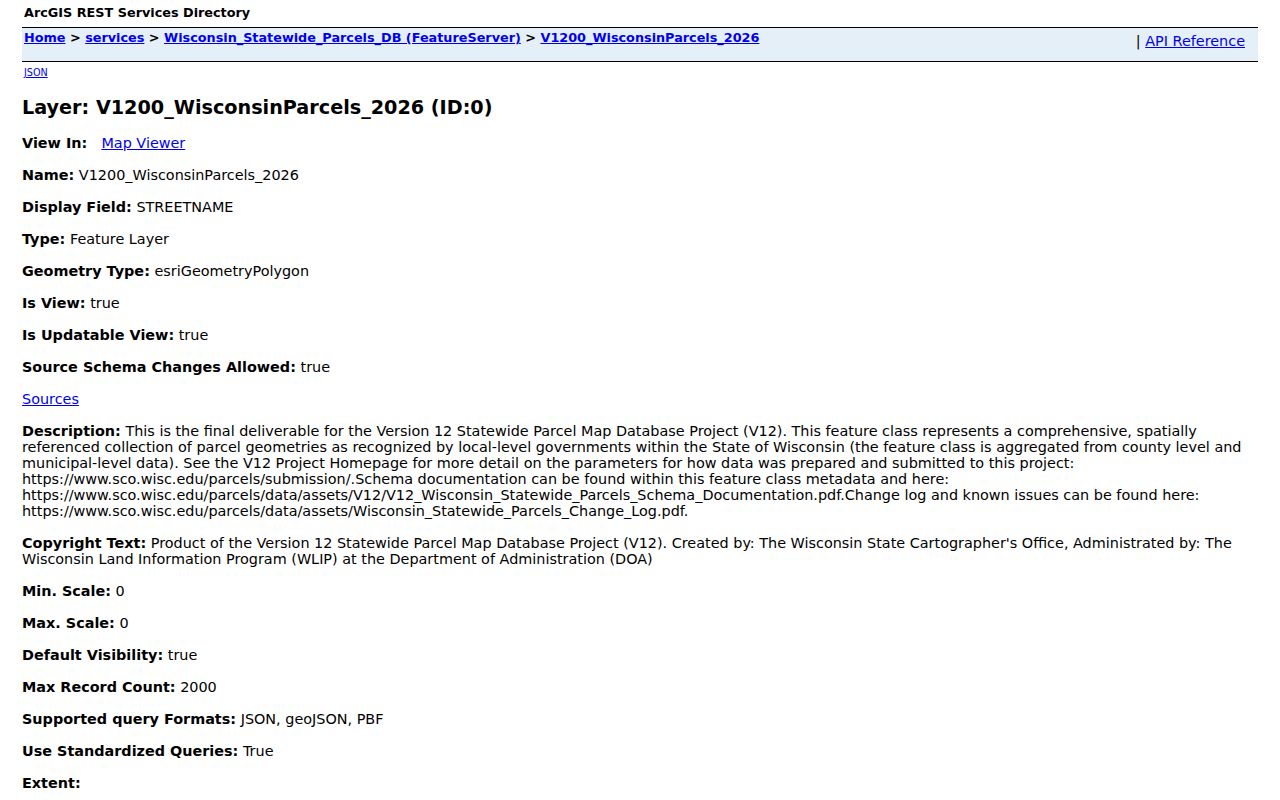
V12 is an inventory of fields. The parcel-specific owner value comes from the county or municipal record.
Wisconsin's Assessment Date Sets the Roll
Every owner field carries an as-of date. Wisconsin assessors work to the January 1 assessment date. The clerk delivers a new tax roll to the treasurer in December. A mid-year transfer can show up in the Register of Deeds first. The next roll reflects it later. That gap is about timing, not error. On V12, check the parcel date and tax-roll year. Then ask the local assessor or RPL when the owner field last changed. The 2026 Property Assessment Manual from DOR describes the assessment roll and local RPL duties. A statewide load date tells you nothing here. It will not show when a municipality last touched its own card.
The Department of Revenue's Real Estate Transfer Return search can help with a recent filing. It can also surface a document reference. It is a starting point. But sales reporting is not a live ownership certificate. Assessment exports can drop automatically rejected non-arm's-length transactions. These include gifts, exempt-fee transfers, and partial-interest conveyances. If a sale result appears, follow it to the recorded deed. If nothing appears, do not assume the parcel never transferred.
Wisconsin V12 Owner Data Has a Source
The 2026 V12 release adds a statewide view of owner, address, value, and tax fields, and its public REST layer lists a June 30, 2026 data/edit date. The owner attribute comes from a county or municipality. It may be older. Kenosha County's prior layer carried full owner-name redaction under a county-board resolution. Other places submit partial fields or different redactions.
Save the county, source, parcel date, load date, and tax-roll year with any owner result. A blank state layer is a clue. So is one dated earlier than the local card. Either way, continue with the local custodian, because the local assessor or RPL remains the source for the current parcel record.
The State Cartographer's Office V12 page links current state and county downloads.
Verify the Current Wisconsin Owner
Start with the assessor roll to find the present owner field. Then check the newest deed. The county Register of Deeds index holds it. The RPL and assessor may update on different schedules, so a recently recorded instrument can be newer than the annual roll. Record the tax-roll year and recording date.
- Find the local assessor or RPL through the Wisconsin DOR county or assessor directory.
- Search the parcel and note owner name, source, tax-roll year, situs, mailing address, and legal description.
- Search the county ROD for the most recent deed affecting that parcel and compare the named grantee.
- If the grantee is a business, confirm its legal name and status in DFI without assuming the agent is its owner.
- If dates differ, keep both records and ask the local custodian when the roll refreshes.
On the deed itself, compare more than a name. Check the parcel's legal description and the grantee's capacity as well. A trust may name a trustee, and an estate transfer may identify a personal representative. The assessment card can shorten or normalize those names. Indexes sometimes show only an abstract. Request the recorded instrument from the county Register of Deeds. Cite its document number or recording date. Public-records access rules govern an existing copy request. But the county office sets its own search method, delivery options, and charges.
- Owner of record
- The party listed by a specific public custodian.
- Assessment roll
- The municipality's annual list of taxable property.
- Situs address
- The property's physical location, distinct from its mailing address.
- Recording lag
- The time between a filed instrument and its reflection in a local roll or map feed.
Need the whole picture? The fuller Wisconsin owner-finding method starts with the address and explains which office supplies each part of the answer.
Wisconsin Mailing and Situs Fields Differ
The situs field tells you where the parcel sits. The mailing address shows where the tax bill goes. Often they match, but owners frequently split them. A current owner of record may list a post-office box, a company address, a management office, or a registered agent instead of the street address. Vacant parcels sometimes carry no physical address at all. Multi-unit buildings can stack several units onto one parcel. Treat both fields as matching tools, not proof of occupancy.
Wisconsin V12 stores the full mailing address, the full physical address, and a standardized site address. ZIP codes follow postal delivery routes rather than municipal or county borders, so a mailing city that differs from the taxing municipality is normal; use the parcel source and the local assessor directory to route the record.
Wisconsin Company Owners Have Limits
The owner of record is not always a person. LLCs, corporations, trusts, and estates all hold Wisconsin parcels. For a business, DFI Corporate Records answers structural questions. It confirms the legal name, entity type, status, registered agent and office, entity ID, effective date, and filing history. Members of domestic LLCs are not listed there. The registered agent accepts service of process and may hold no ownership interest at all.
Match the exact owner name on the deed. A trustee, personal representative, or estate name can appear on the deed or the tax roll instead of a living beneficiary. Probate files may explain a transfer after death, but the recorded instrument is what reaches the land record. The Wisconsin DFI entity search works as an identity cross-check, not proof of who benefits from the parcel.
Protected Wisconsin Owner Addresses
Some real addresses never reach public fields. Wisconsin's Safe at Home program gives participants a substitute address. Agencies then use that assigned address in place of the person's home address. Act 235 also affects public owner data. A blank or substituted address can be lawful. Never combine unrelated records to expose a protected location. The same caution applies to sensitive personal details inside an old instrument. Those details should never be republished.
The Register of Deeds or the land-information office can say what may be released. The Wisconsin Safe at Home guidance explains why an assigned address can appear. Public records can lawfully show that substitute in place of a home address.
Wisconsin Current Owner Contact Limits
A tax-roll mailing address is only a clue. It may belong to a business, trust, agent, or post-office box. It proves nothing about where the owner lives. Wisconsin's Safe at Home program offers confidentiality rules. These rules can replace or redact protected addresses in the property records. Respect blanks and ask the custodian what may be released.
Lawful property use. Do not use owner records to stalk, threaten, or harass another person. The recorded deed confirms an instrument; a title professional interprets ownership and encumbrances when that conclusion is needed.